
NASA Marks 2025 as Landmark Year for Space Exploration
By Avery Collins. Dec 29, 2025

NASA closed 2025 describing it as the launch of "a new golden age of
exploration and innovation," citing a year that included the completion
of the Nancy Grace Roman Space Telescope, preparations for the Artemis
II crewed Moon mission, two lunar landings, and the Hubble Space
Telescope's 35th anniversary milestone, according to NASA's official
year-in-review report. The agency also grew the Artemis Accords — its
framework for international space cooperation — to 59 signatory
nations.
The breadth of those accomplishments across a single year reflects
NASA's simultaneous operation of multiple major programs: deep-space
science observatories, crewed exploration missions, commercial lunar
delivery partnerships, and planetary science campaigns.
The Nancy Grace Roman Space Telescope
The most significant hardware milestone of 2025 was the completion of
the Nancy Grace Roman Space Telescope, which finished construction and
entered final testing ahead of a launch targeted for as early as fall
2026, according to NASA. Named for NASA's first Chief of Astronomy —
known as the "Mother of Hubble" for her role in making that telescope
a reality — Roman is designed to survey large regions of sky in
infrared wavelengths, studying dark energy, dark matter, exoplanets, and
the large-scale structure of the universe.
Roman's wide-field capability complements the James Webb Space
Telescope, which entered its third year of science operations in 2025
and released a 2.5-gigapixel Andromeda galaxy mosaic to mark the Hubble
Space Telescope's 35th anniversary, per NASA's Johnson Space Center
milestone report.
Artemis II on the Horizon
NASA's Johnson Space Center confirmed that the Artemis II crew —
Commander Reid Wiseman, Pilot Victor Glover, Mission Specialist
Christina Koch, and Canadian Space Agency Mission Specialist Jeremy
Hansen — completed final preparations in 2025 for the first crewed
lunar flyby mission since the Apollo program, according to NASA
Johnson's 2025 milestone report.
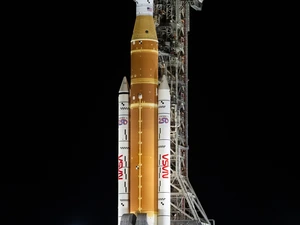
Artemis II is targeting launch no earlier than spring 2026. The ten-day
mission will fly the four-person crew around the Moon and back to Earth
aboard the Orion spacecraft atop the Space Launch System rocket —
validating the hardware and procedures required before NASA attempts to
land astronauts on the lunar surface with Artemis III.
Two Lunar Landings
Among the year's other accomplishments, NASA delivered two separate
science payloads to the lunar surface through its Commercial Lunar
Payload Services program in 2025, according to NASA's year-in-review.
The program partners NASA with commercial companies to develop and
operate lunar landers, building the delivery infrastructure needed for
sustained scientific presence on and around the Moon ahead of crewed
surface missions.
The accumulation of these milestones across a single calendar year
reflects the scale of what NASA is managing simultaneously — from
human spaceflight preparation to robotic science missions to
international partnership-building — as it moves into what the agency
has formally described as a new era of exploration.
References: Nasa Ignites New Golden Age Of Exploration Innovation In 2025 | Nasa Johnsons 2025 Milestones

The News Command team was assisted by generative AI technology in creating this content
Trending
Read More

Read More

Read More

Read More

Read More

Read More

Read More

Read More

Read More

Read More

Read More

Read More

Read More

Read More

Read More

Read More

Read More

Read More

Read More

Read More

Read More

Read More

Read More

Read More