
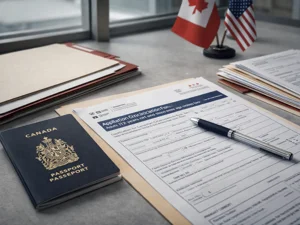
Americans Surge Toward Canadian Citizenship After Law Change
By Cameron Hale. Apr 20, 2026
When Canada’s Bill C-3 took effect on December 15, 2025, it quietly erased a generational limit that had barred many Americans from claiming Canadian citizenship through family ancestry. The change reversed a rule imposed in 2009 that had prevented Canadians born abroad from passing their citizenship to children also born outside the country. Once it cleared, an unfamiliar pathway opened for millions of Americans with Canadian ancestry going back generations - and a notable share of them moved quickly to use it.
By January 2026, U.S. citizens accounted for roughly 2,500 citizenship-by-descent applications filed with Immigration, Refugees and Citizenship Canada - more than the combined total from the next nine source countries, which included the United Kingdom, France, China, and India, according to Canadian Press data reported on April 16. The immigration department received more than 12,000 total citizenship-by-descent applications between December 15 and the end of January alone.
Archives Overwhelmed, Consultants Stretched
The administrative effects showed up almost immediately in the institutions that support the application process. The Bibliotheque et Archives nationales du Quebec reported that requests from the United States for vital records jumped from 100 in February 2025 to 1,500 in February 2026, according to CNN. Archives across New Brunswick, British Columbia, Newfoundland, and Ontario reported similar surges.
Ottawa-based regulated immigration consultant Cassandra Fultz told CNN her American caseload rose tenfold since the law changed - from roughly 10 applications per month to around 100. Fultz, who has worked in the field for 17 years, said this wave is unlike anything she has observed after previous U.S. election cycles, when interest in Canadian citizenship would typically peak in November and fade by January. This time, demand has remained steady and continued to climb.
Who Is Applying and Why
CNN’s reporting, published March 30, put names and circumstances to the trend. Ellen Robillard, 52, a Democratic committee leader from a suburb of Rochester, New York, whose mother was born in Nova Scotia, is applying alongside her adult son. She told CNN she wants the option available if conditions in the U.S. deteriorate further. Rachel Rabb, an American living in Latin America, discovered through ancestry research that her great-great-grandmother was born in Ontario. For her, the citizenship application functions as what she described as a safety net.
Not all applicants are motivated by political concerns. Timothy Beaulieu, 45, of New Hampshire, has spent years reconnecting with his French-Canadian heritage through Franco-American associations and travel to Quebec and New Brunswick. He told CNN he would be applying with equal enthusiasm regardless of the current political environment. Immigration consultants report that career opportunities, family reunification, and cultural connection are also common drivers.
A Law Correcting a Legal Wrong
Fultz emphasized to CNN that Bill C-3 was not designed as a response to American emigration interest. The legislation was drafted to comply with a 2023 Ontario Superior Court ruling that found the prior first-generation limit unconstitutional and discriminatory. The change also restores citizenship to so-called “Lost Canadians” - individuals who lost or never obtained citizenship due to rules the courts have since found invalid.
Some Canadians have expressed frustration online that the process appears easier for Americans with distant ancestry than for immigrant households navigating lengthy standard procedures. Fultz pushed back on that framing, telling CNN: “Basically, the outcome of this case is that a Canadian is a Canadian is a Canadian.” The processing time for citizenship certificates from the U.S. currently stands at approximately 10 months, with more than 50,000 applications in queue as of late March, according to the immigration department.
The Practical Reality of a Plan B
What the application surge reveals, more than anything, is a measurable shift in how a segment of the American public is thinking about optionality. Most applicants told CNN they are not planning to relocate immediately. The citizenship is being secured as a contingency - a documented alternative that did not exist for many of them two years ago and may never need to be used.
Whether the volume of applications translates into actual relocations at meaningful scale remains an open question. What is documented is the behavior itself: Americans from New Hampshire to Michigan to Texas digging through family records, contacting provincial archives, and discovering connections to Canada that their grandparents or great-grandparents left behind. The law changed. The paperwork followed.
References: Americans Are Rushing to Get Canadian Citizenship by Descent | US leads interest by wide margin in getting Canadian citizenship by descent

The News Command team was assisted by generative AI technology in creating this content
Trending






Read More


Read More

Read More


Read More



Read More


Read More

Read More

Read More

Read More

Read More

Read More

Read More

Read More

Read More