
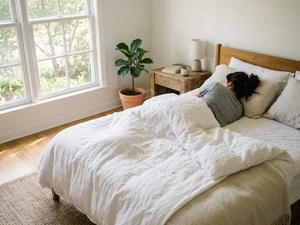
Study Links Sleep Range to Healthy Aging
By Cameron Hale. Jun 23, 2026
The Finding
A large study has linked a specific nightly sleep range to healthier biological aging, suggesting that both too little and too much sleep track with faster aging across the body. Researchers drew on data from the UK Biobank, a long-running database holding health records for roughly 500,000 participants, to examine how sleep duration related to measurable aging across multiple organ systems.
The analysis pointed to a range of about 6.4 to 7.8 hours per night as the window associated with the slowest measured aging. Sleeping less than that range, or substantially more, corresponded with signs of accelerated aging, producing a U-shaped pattern in which the middle of the range looked healthiest.
How Researchers Measured It
The study’s methodology is what gives the finding its weight. Rather than relying on a single marker, researchers assessed aging across a set of biological systems, examining clocks tied to multiple organs. The work tracked indicators across 23 such clocks spanning 17 organs, allowing the team to look at aging as a whole-body process rather than a single number.
That breadth matters because sleep affects systems differently. A measure that captured only one organ might miss the broader pattern. By spreading the analysis across many systems, the researchers could observe whether the same sleep range lined up with slower aging consistently, which is what the U-shaped result suggests.
The reliance on the UK Biobank also strengthens the picture. With around half a million participants, the dataset is large enough to detect patterns that smaller studies might not, and it links self-reported and measured data over time. The findings were published in a peer-reviewed venue and summarized by institutions including Columbia University.
What the Numbers Mean
The practical reading is narrower than it might first appear. The study identifies an association, not a prescription, and a correlation between a sleep range and slower measured aging does not establish that adjusting sleep alone changes the outcome. People who sleep within the identified range may differ from others in ways the analysis cannot fully separate.
Still, the consistency across organ systems is notable. The same window kept surfacing as the healthiest across many measures, which is harder to dismiss than a single isolated result. The U-shape also lines up with earlier research suggesting that very short and very long sleep can both carry health costs.
Why It Resonates
Sleep advice tends to arrive as a single target, often “eight hours,” and this study complicates that shorthand. It suggests a band rather than a fixed point, and it places the healthiest window slightly below the familiar eight-hour figure, which is part of why the finding drew attention.
The whole-body framing also reshapes how people might think about rest. By tying sleep to aging across many organ systems at once, the research treats a night’s sleep as something that touches the entire body rather than a single function, reinforcing why duration outside the range showed up consistently across so many measures.
The research adds to a growing body of work treating sleep as a measurable input to long-term health rather than a matter of habit or preference. For readers, the takeaway is less a rule than a reference point: a range that the data associates with slower aging, derived from one of the largest health datasets available.
Where the Science Stands
The study establishes an association between a roughly 6.4-to-7.8-hour nightly range and slower biological aging across multiple organ systems, drawn from about 500,000 UK Biobank participants and assessed across 23 organ clocks. It does not claim that sleep is the sole driver of aging or that hitting the range guarantees a particular outcome.
Researchers framed the result as a contribution to understanding how sleep relates to aging, not as a final answer. Further work would be needed to test whether changing sleep duration shifts the measured aging markers. For now, the finding stands as a large-scale association worth noting rather than a directive to follow.
References: S41586 026 10524 5 - Nature | Sleeping Hours and Aging - Verywell Health

The News Command team was assisted by generative AI technology in creating this content
Trending

Read More

Read More

Read More

Read More

Read More

Read More

Read More

Read More

Read More

Read More

Read More

Read More

Read More

Read More
Read More

Read More

Read More

Read More

Read More

Read More

Read More

Read More

Read More

Read More