
The 2026 World Cup Logistics Nightmare
By Morgan Blake. May 25, 2026
The Scale of History
For the first time, the FIFA World Cup is expanding beyond tradition. The 2026 tournament will feature 48 teams-up from 32-competing across three countries: the United States, Mexico, and Canada. According to FIFA, 104 matches will unfold across 16 venues from June 11 to July 19. That’s the largest World Cup ever attempted, and it presents logistical challenges that dwarf all previous tournaments.
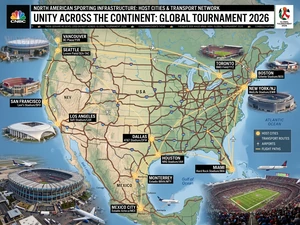
The United States will host the majority of matches, with 78 games spread across 11 cities. Mexico and Canada will each host 13 matches in their respective regions. The sheer geographic span-stretching from Vancouver to Miami-means teams will spend substantial time traveling between group-stage matches.
The Travel Arithmetic
Coordinating teams across three nations and four time zones requires unprecedented planning. According to tournament officials, the group stage will span 16 days with 72 matches, while the knockout stage adds 32 more games across two weeks. Teams will move through regional clusters designed to minimize excessive travel during group play, but once the knockout rounds begin, matches can be held anywhere within the three-country footprint.
According to FOX Sports reporting, the opening match on June 11 will kick off in Mexico City, while the final is scheduled for July 19 at New York New Jersey Stadium in East Rutherford, New Jersey. This linear distance alone-nearly 2,000 miles-represents the scale at which organizers are working.
Infrastructure and Timing
The 39-day tournament duration-roughly a week longer than previous World Cups-creates cascading scheduling challenges for venue management. Eleven U.S. cities will participate: Atlanta, Boston, Dallas, Houston, Kansas City, Los Angeles, Miami, New York/New Jersey, Philadelphia, Seattle, and the San Francisco Bay Area. Three Mexican cities-Mexico City, Guadalajara, and Monterrey-plus Toronto and Vancouver in Canada round out the 16 venues.
Each stadium must be prepared to FIFA standards, with backup plans for weather delays, field maintenance windows, and crowd management across multiple events. According to Britannica’s reporting on the tournament, the expanded format required FIFA to restructure qualification protocols and group composition to accommodate 48 teams rather than 32.
Why Size Matters
The tournament expansion represents FIFA’s push for global growth and increased commercial revenue. According to reporting from Britannica, FIFA projects $11 billion in revenue from the 2026 World Cup-a 57 percent increase from the $7 billion earned during Qatar 2022. The added matches and broader geographic footprint mean more broadcasting windows across global time zones and expanded ticket availability.
Yet with that growth comes operational strain. Coordinating air travel for 48 nations, managing security across multiple borders, synchronizing match schedules across four time zones, and maintaining field quality through an extended schedule all test the limits of modern event logistics. The tournament will serve as a blueprint for how international sports can scale to unprecedented sizes.
References: Britannica: 2026 FIFA World Cup | FOX Sports: 2026 FIFA World Cup How to Watch | Turkiye Today: 2026 FIFA World Cup 48 Teams

The News Command team was assisted by generative AI technology in creating this content
Trending






Read More


Read More

Read More


Read More



Read More


Read More

Read More

Read More

Read More

Read More

Read More
Read More

Read More

Read More