
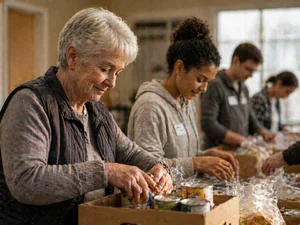
Volunteers Over 60 Show Slower Biological Aging in New Study
By Jordan Mercer. Apr 15, 2026
The Finding Most People Don’t Expect
Most people think about aging in terms of what they eat, how much they exercise, or their family history. Those factors matter. But research is now pointing to something that doesn’t require a gym membership or a diet change – giving your time to others. A 2025 study published in Social Science & Medicine found that older adults who volunteered showed measurably slower biological aging than those who did not, even after researchers controlled for baseline health, socioeconomic status, education, and physical activity. The study drew on data from the long-running Health and Retirement Study, one of the most comprehensive longitudinal datasets on aging in the United States.
The Washington Post covered the findings alongside additional research linking purpose-driven activity to longevity, noting that the effect appears to operate through multiple pathways – social, physical, and psychological – simultaneously.
How Researchers Measured Biological Age
The study didn’t simply ask participants how healthy they felt. It used epigenetic clocks – scientific tools that track changes in DNA methylation to estimate how rapidly the body is aging at the cellular level. These clocks are increasingly used in aging research because they can detect biological aging patterns that standard health measures miss.
Older adults with regular volunteering habits showed younger biological profiles on these measures compared to non-volunteers with similar demographics and health histories. The effect was present even among participants who were already retired, suggesting the benefit is not simply a byproduct of staying employed or physically active in other ways.
The Cornell Research That Adds Another Layer
A separate study from Cornell University, published in October 2025 in Brain, Behavior and Immunity, adds to the picture from a different angle. That research examined more than 2,100 adults who participated in the Midlife in the United States study and found that people with greater cumulative social advantage – a measure that includes community involvement and ongoing emotional support from others – displayed younger biological profiles on two established aging clocks and lower levels of interleukin-6, a pro-inflammatory marker linked to heart disease and neurodegeneration.
“Think of social connections like a retirement account,” said Anthony Ong, a Cornell psychology professor who led the research. “The earlier you start investing and the more consistently you contribute, the greater your returns. Our study shows those returns aren’t just emotional – they’re biological.”
The volunteering study and the Cornell research reinforce each other: purpose-driven engagement with others, whether through formal volunteering or sustained social connection, appears to have measurable effects on how the body ages.
Real People, Real Results
The research echoes what practitioners who work with older adults have observed for years. One of the most frequently cited examples in the longevity literature is the Baltimore Experience Corps Trial, which studied the health effects of placing older adults as volunteers in elementary schools. Women in the program showed significant increases in daily walking and, in subsequent research, demonstrated slowed or reversed declines in brain volume in regions vulnerable to cognitive disease.
These are not abstract statistics. They describe what happens when people with decades of experience are given a structured reason to show up somewhere that needs them.
What This Means for Your Next Chapter
For readers navigating retirement or the years approaching it, the research offers a reframe worth sitting with. The question isn’t only what you’ll stop doing when you leave the workforce – it’s what you’ll start doing that gives you a reason to keep showing up. The biological data now suggests that the answer to that question may matter more than most people realize. Volunteering even a few hours a week appears to produce measurable returns, not just for the communities served, but for the health and longevity of the people doing the serving.
References: Helping Others May Help You Live Longer | Social Connections and Volunteering Linked to Slower Biological Aging

The News Command team was assisted by generative AI technology in creating this content
Trending

Read More
Read More

Read More

Read More

Read More

Read More
Read More
Read More

Read More

Read More
Read More

Read More

Read More
Read More
Read More
Read More

Read More

Read More

Read More

Read More

Read More
Read More
Read More

Read More